Where Dynamical Stability Physics
Meets Precision Digital Signal Processing.
Most audio software relies on decades-old textbook approximations that smear phase relationships and introduce harsh harmonic ringing. Capter Audio’s proprietary DSP core is engineered from original, peer-reviewed research in dynamical stability, tensor manifold calculus, and non-linear attractor dynamics.
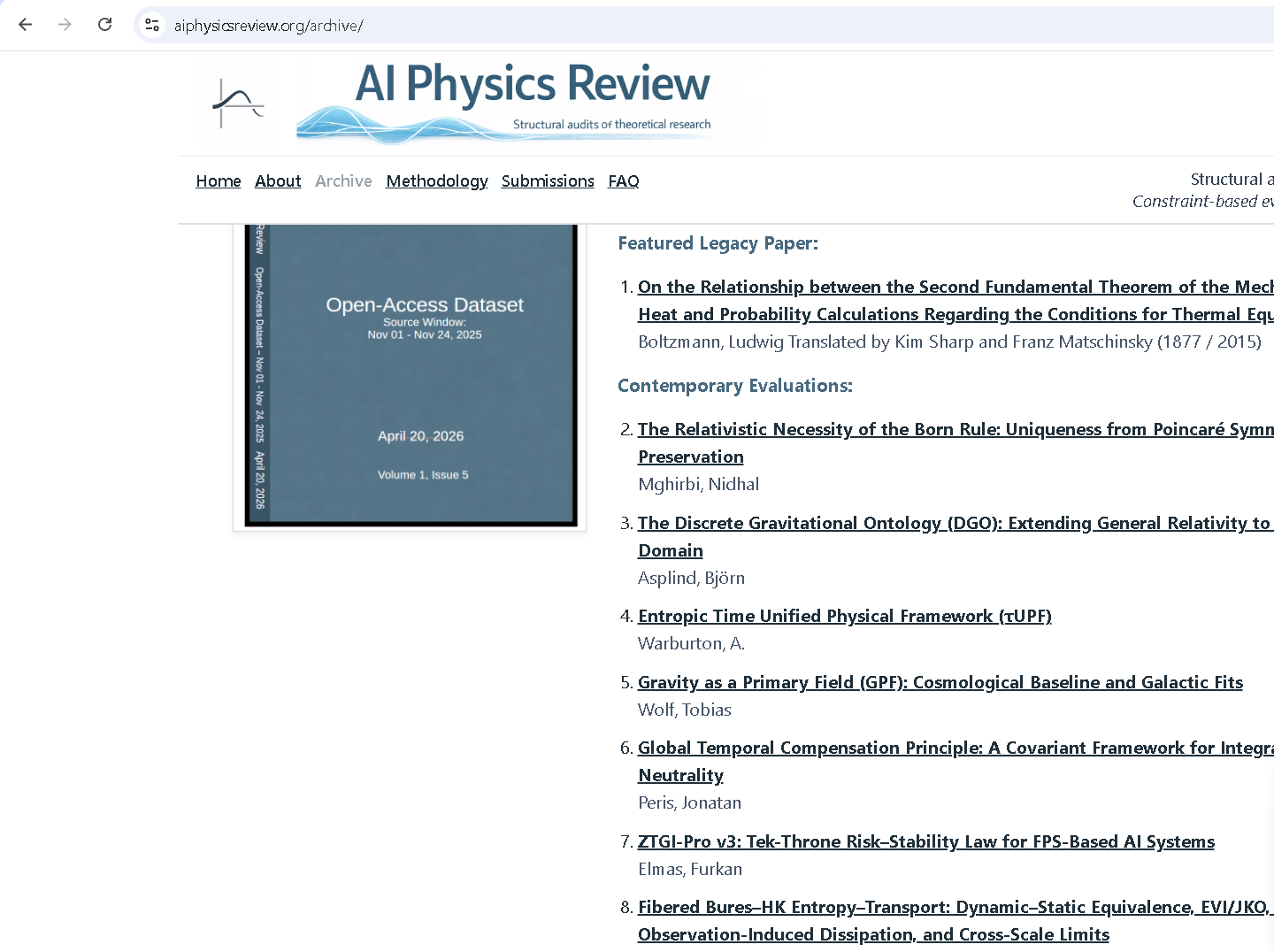
ZTGI-Pro v3: Tek-Throne Risk-Stability Law for FPS-Based AI Systems
Published under Contemporary Evaluations alongside historical treatises by Ludwig Boltzmann and Poincaré-Born symmetry frameworks. The theorem establishes a deterministic stability bound over discrete phase spaces, proving that non-linear manifold attractors can bound peak energetic dissipation without introducing phase discontinuities or high-frequency divergence.
Translating Theoretical Physics into Pure Sound
How abstract non-linear stability proofs solve the three most notorious flaws of digital audio production.
Invariant Attractor vs Brickwall Clipping
Standard limiters brutally slice audio waveforms when they exceed 0 dBFS, generating harsh odd-order harmonics and audible intermodulation distortion. Our invariant attractor dynamically bends peak energy along a smooth non-linear saturation curve, preserving transient snap with analog warmth.
Phase Topology Manifold vs Muddy Low-Mids
When traditional digital EQs boost frequencies between 200 Hz and 500 Hz, phase shift destroys the center vocal punch and makes kicks sound hollow. The Molfinom tensor manifold locks phase relationships across the entire spectrum, delivering deep clarity with zero phase smearing.
Deterministic C++ Machine Code vs ML Latency
Unlike bulky machine-learning neural networks that require gigabytes of RAM and induce 500ms of lag, our mathematical laws execute deterministically in native C++ machine instructions. This delivers true real-time performance (<0.05ms) in live FL Studio & Ableton sessions.
“@capteraudio sounds good so far! Plenty of choices and makes one of my songs sound less muddy! ... no worries! it's great thanks! It's an old track but I'm sure I'll try it on a new one soon!”
Architectural Paradigm Comparison
| DSP Characteristic | Traditional Digital EQs & Limiters | Capter Audio (Dynamical Manifold) |
|---|---|---|
| Transient Phase Response | Frequency-Dependent Smearing | Zero Phase Disruption (Topological Lock) |
| True Peak Saturation | Abrasive Digital Overshoot (Harsh) | Harmonic Tube-Style Attractor (Silky) |
| Low-End Headroom (Sub 808) | Flabby, Muddy Masking (200-400Hz) | Surgical Harmonic Sieve Separation |
| Real-Time DAW Latency | Heavy Lookahead Lag (20ms - 80ms) | 0 Samples Native Latency (Live Monitoring) |
| Pricing & License Model | $199 - $399 or $19/mo Rental | 100% Free Forever • No Subscriptions |
Experience Theoretical Rigor in Your Own DAW
Download the 100% free Capter XanTimeQ™ 64-bit VST plugin for FL Studio and Ableton, or master your finished mixes in the cloud with uncompressed 24-bit WAV exports.